Case Study:
JCMC
Manuscript Governance & Global Editorial Operations
The Challenge
As the primary operational node for the Journal of Computer-Mediated Communication (JCMC), I managed a high-volume manuscript pipeline for one of the field’s flagship publications. Coordinating a decentralized board of 40+ international editors and hundreds of global contributors required 100% data integrity, strict version control, and the ability to navigate complex stakeholder dependencies across 12+ time zones.
The Solution
I served as the "Air Traffic Controller" for the peer-review lifecycle. By engineering standardized triage protocols, managing the technical interface between the editorial board and Oxford University Press (OUP), and designing and stewarding a decentralized workflow architecture to automate tracking, I ensured the journal maintained its rigorous double-blind integrity and publication deadlines and ensured transparency throughout the peer-review lifecycle.
SCHOLARLY TRIAGE & METADATA INTEGRITY
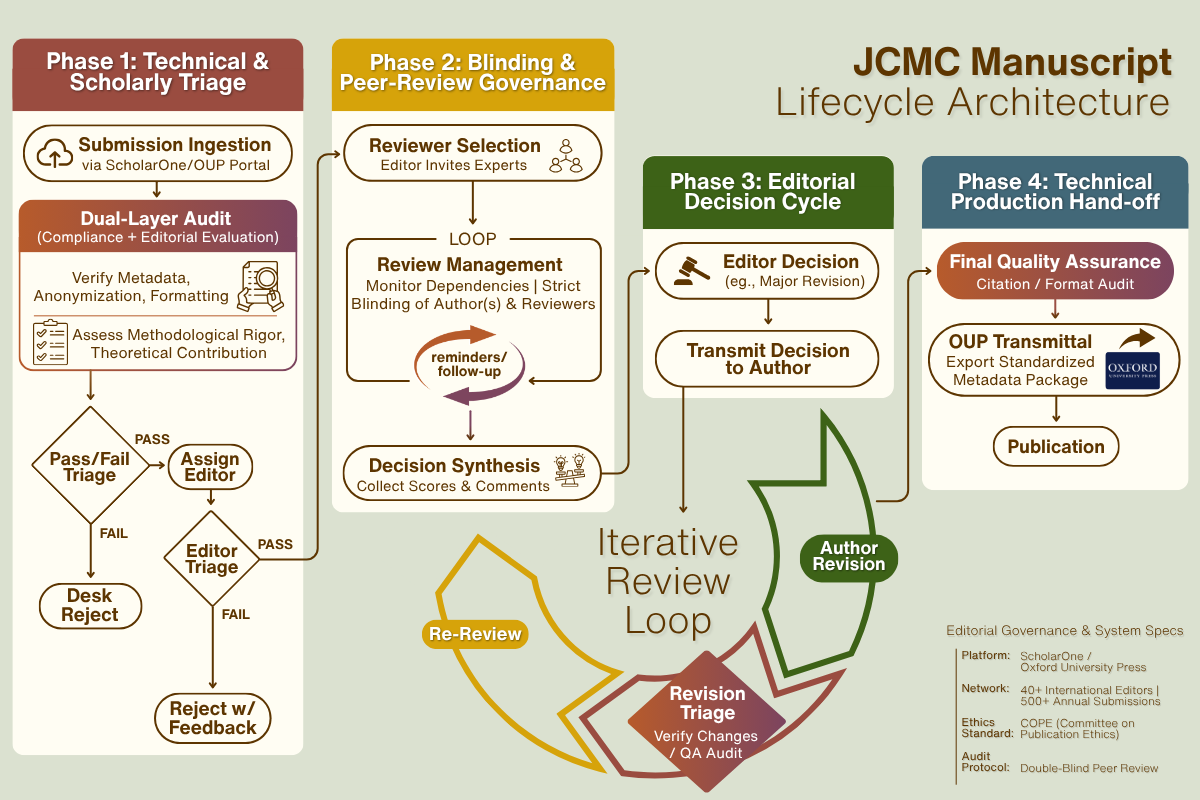
I managed the ingestion of 500+ global research submissions annually, serving as the first point of evaluation for the journal. Beyond technical compliance (metadata/blinding), I performed qualitative audits of incoming manuscripts to evaluate methodological rigor, theoretical contribution, and alignment with journal scope. This required a dual-layer audit of all incoming assets to ensure they met both institutional standards and scholarly requirements.
- System Stewardship: Managed the ScholarOne/Oxford University Press portal, ensuring all incoming data met strict structural requirements for global distribution.
- Asset Anonymization: Enforced double-blind protocols by auditing all files for "hidden" metadata or identifiers, protecting the integrity of the peer-review process.
- Pipeline Optimization: Conducted high-level qualitative audits of manuscripts to evaluate methodological rigor and journal fit, streamlining the editorial workflow by ensuring only high-potential research progressed to the board.
GLOBAL PIPELINE GOVERNANCE
Managing the review cycle required balancing high-stakes deadlines with the availability of international subject-matter experts. I designed internal tracking systems to monitor reviewer dependencies and mitigate bottlenecks, ensuring no manuscript stalled in the pipeline.
- Stakeholder Coordination: Liaised with a global board of editors to assign manuscripts, manage deadline extensions, and prioritize high-volume submission periods.
- Recursive Review Management: Oversaw the iterative peer-review loop, ensuring that revised manuscripts were accurately routed back to original reviewers and that author responses were technically sound.
- Procedural Accuracy: Maintained zero procedural failures across the entire editorial cycle, ensuring all manuscripts met ethical and technical publication standards.
SYSTEMS INTEGRATION & PUBLISHER RELATIONS
I acted as the technical liaison between the editorial board and Oxford University Press production teams. This involved translating complex editorial decisions into standardized reports and ensuring that all finalized assets met the technical and legal requirements for digital and print distribution.
- Quality Assurance: Conducted final audits of revised manuscripts to verify that all requested technical and formatting changes were implemented prior to production.
- Data Export: Finalized and exported high-fidelity metadata packages to OUP, ensuring seamless integration into international research databases.
JCMC Manuscript Lifecycle Architecture. A comprehensive system process map illustrating the end-to-end governance of research submissions. This visual highlights the technical and scholarly triage checkpoints, the recursive peer-review loop, and the final production hand-off to Oxford University Press.
The Impact
SCALABILITY
Successfully stewarded a high-volume global research pipeline with zero loss in data integrity.
EFFICIENCY
Streamlined the "Triage-to-Editor" timeline by standardizing both technical and qualitative ingestion checklists.
GLOBAL ALIGNMENT
Maintained operational continuity across a decentralized international team of editors, reviewers, and publishers.